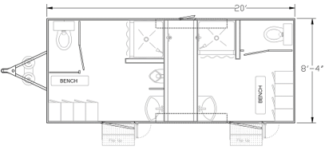
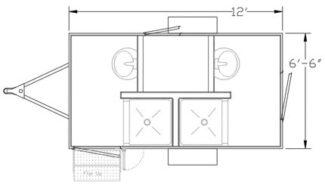
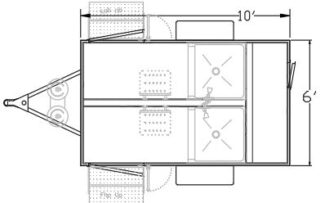
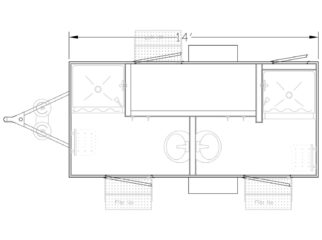
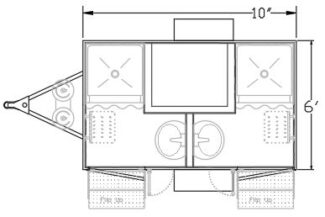
Decontamination (decon) trailers provide the spaces to decontaminate workers or people at sites or incidents involving hazardous debris or materials such as fuels, toxic chemicals and biological, chemical or radiological agents.
Comforts of Home creates versatile, customized decon trailers and dropbox skid units for the safe, efficient removal of hazardous materials from people, equipment and other materials before they re-enter a safe environment.
Our custom units can often be seen serving critical missions for:
- emergency response
- military operations & units
- power plants
- hazmat teams
- homeland security
- oil refineries
- field hospitals
- construction companies
- industrial-chemical projects
- industrial sites
- lead & asbestos abatement
- mass decontamination
- biothreat response
- quarantine zones
- fire & police departments
We also manufacture custom models for specialty clean-up.
Decon Trailers: Not Combo Trailers
Decontamination trailers differ from combination trailers in notable ways.
Standard combo trailers are designed for convenience at sites and events, such as concerts, summer camps, outdoor festivals and community-outreach initiatives.
They typically include showers, toilets and sinks with basic plumbing. Wastewater usually goes to a holding tank or a sewer hookup. In particular, the trailers focus on hygiene and comfort as opposed to handling hazardous waste.
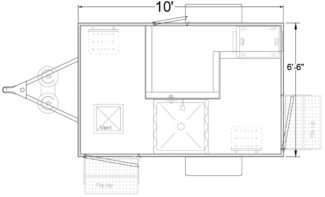
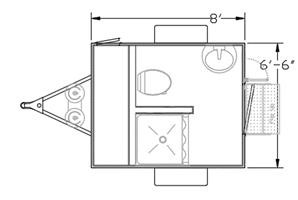
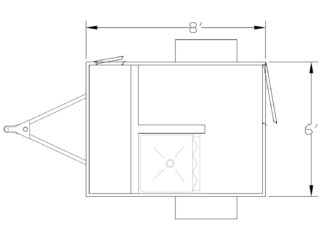
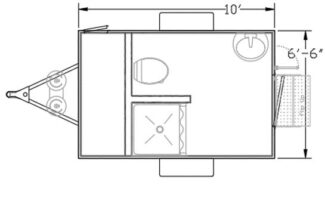
A decon trailer is built specifically for safe hazard. A Comforts of Home custom unit features a shower for rinsing off contaminants. During the process, the individual will enter a “dirty room,” shed the contaminated clothing, rinse and then continue to a “clean room.”
Unlike wastewater in combo trailers, contaminated runoff must be kept away from a normal sewer. For safety, decon trailers are specially equipped for containment and filtration.
Other custom elements in decon trailers might be:
- single- to multi-shower floor plan
- eye flush-out stations
- onboard freshwater & wastewater tanks
- off-the-grid power (propane, generators)
- washer & dryer
- storage areas (including for protective gear)
- toilets
- exterior washout sinks
- lockers
- cold-weather operation package
A heavy-duty steel frame, foldaway access steps and full-sized aluminum hinged doors can further reinforce high performance with extra durability.
With the custom features you specify, your Comforts of Home decon trailer is easily deployable for immediate use and results.
Decontamination Trailers: Core Components
Our decon trailers adapt to your definition of use and scale. The following are several of the functional components you can discuss with your Comforts of Home trailer-solutions adviser.
| Structure | Decontamination | HVAC & Air Control |
|---|---|---|
| Trailer frame & chassis | Showers | Ventilation system |
| Interior walls & ceilings | Eyewash stations | Negative-pressure option |
| Flooring | Water tanks | Heating & cooling system |
| Doors & ramps | Water-heating system | |
| Partitions | Wastewater management |
| Power & Utilities | Interior Fixtures & Furnishings | Safety & Compliance |
|---|---|---|
| Onboard generator | Seating & benches | Non-slip surfaces & handrails |
| Shore power connection | Lockers & cubbies | Emergency showers |
| Lighting | Shelving & cabinets | Fire alarms & extinguishers |
| Electrical outlets | Hooks & racks | Marked directional flow |
Decontamination Trailers: Design Considerations
Because your decon trailer must be safe, practical, adaptive and compliant with regulations, you and your trailer-solutions adviser can discuss important design considerations such as the following.
- Purpose & use. The intended application will shape the decon trailer’s layout, material and equipment requirements. For example, a trailer at a hazmat spill and a trailer serving hospital-surge capacity will include different features.
- Layout & flow. Particulars might include zoning (separation of hot, warm and cold areas); one-way traffic to prevent back-tracking of contaminants; various stations (e.g. showers, dressing areas, storage for clean and contaminated gear); and ADA compliance if needed for public or emergency use.
- Water & waste management. The trailer may need capacity for multiple users of water, as well as onboard tanks or external hookups depending on the use. Temperature control can allow safe, adjustable water temperature. Contaminated water will need to be captured, filtered and disposed of according to regulatory compliance.
- Surfaces & materials. Walls, floors and fixtures will often have to resist harsh chemicals, high-pressure washdowns and repeated use. Non-porous surfaces such as stainless steel and FRP panels will be easier to disinfect. Safety flooring will help prevent slips in wet conditions.
- HVAC & air control. Proper ventilation helps maintain air exchange while preventing buildup of fumes. Negative-pressure zones support containment of airborne contaminants in certain medical or hazardous applications. Onboard climate control facilitates comfort and safety in extreme weather.
- Power & utilities. Generators, battery backups or shore power enable self-sufficiency. Lighting can be bright, waterproof and reliable (e.g. LED). GFCI outlets and waterproof switches reinforce electrical safety.
- Mobility & deployment. The custom trailer must have durable suspension, road legality and ease of transport. Trailer deployment should be easy and quick in emergencies. Stability assets should include wide doors, leveling jacks and non-slip entry ramps.
- Capacity & scalability. You’ll determine how many people can be processed at once in the trailer. Separate male/female lanes or individual stalls might be privacy considerations. If you need expansion capabilities, some decon trailers can connect with tents or other modular units.
- Special features. Depending on your application, your decon trailer might also have medical-monitoring stations (e.g. for vitals), integrated communication systems and secure storage for medical supplies, personal belongings and contaminated clothing.
With Comforts of Home, your decontamination trailer balances function, safety, hygiene, durability, mobility and regulatory compliance in one efficient, versatile unit built for your mission.
Decontamination Trailers: Real-World Scenarios
Comforts of Home decon trailers appear on the scene to serve with diverse characteristics. The following are examples of scenarios where you would find a decon trailer fulfilling a mission in crucial ways.
Freight-Train Derailment
A freight train carrying industrial chemicals derails, rupturing several tankers and releasing hazardous vapor. Emergency firefighters arrive on the scene in full hazmat suits to stop the leaks and rescue residents trapped in nearby houses.
After hours of exposure, the responders are covered in chemical residue. Because the county’s emergency-management team has a decon trailer, the firefighters can enter the unit, follow the zoning process, shower off the chemicals and change into clean clothing.
In addition, the decon trailer’s wastewater tanks capture all contaminated runoff. Several evacuated residents also are able to be processed through the decon trailer before being transferred to shelters.
Disease-Spread Prevention
During an Ebola outbreak, a regional hospital receives patients who have been potentially exposed to the virus while traveling. Before allowing the patients into the main building, the hospital sets up its decon trailer in the parking lot.
In the trailer, patients are able to shower, change into sterile clothing and have their belongings secured before entering the hospital. This protects staff and other patients inside the hospital while ensuring the public that safety protocols are being followed.